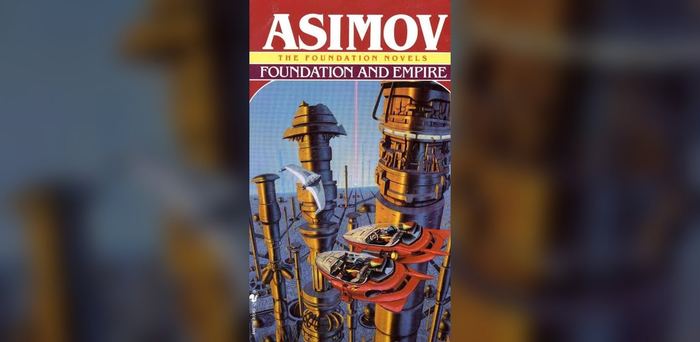
In 1942 a young writer called Isaac Asimov began a run of stories in Astounding Science Fiction about the fall of a galactic empire. They were collected in 1951 as Foundation, grew into a series, and are now an Apple TV adaptation. I read the whole series as a child, twice, and I love it still, so I will try not to spend this whole column explaining why.
The hero is a mathematician, Hari Seldon. He has invented psychohistory: it cannot predict what one person will do, but with enough people it can predict what a civilisation will. And it tells him the Empire will fall, followed by thirty thousand years of darkness. He cannot stop the fall. What he can do is shorten the dark to a thousand years, by setting up a Foundation at the edge of the galaxy: a small, patient institution designed to carry knowledge through the collapse. When each predicted crisis arrives, long after his death, a recording of Seldon appears in a vault and tells the people of the moment what they are living through.
The urge is older than science fiction. Barry Cleveland sent me a piece on the Antikythera mechanism, a two-thousand-year-old box of bronze gears built to see ahead — his piece on it ran in the Wynpress of 5 November.
What I love is that Seldon is not a hero in any ordinary sense. He is a systems designer. He knows he will be dead before any of it matters, so he does what every engineer building something meant to outlive them has to do: he puts the intent into the structure. The people who come later do not need to understand the plan. They need an institution that keeps pointing them the right way.
Which brings me to a foundation of our own.
November is Rotary Foundation Month. In 1917 the outgoing president of Rotary International, Arch Klumph, proposed an endowment “for the purpose of doing good in the world”. The first gift came from the Rotary Club of Kansas City: twenty-six dollars and fifty cents. Jinne, what a modest start. Nobody in that room could have known what it would one day pay for — polio eradication, and the global grants that clubs like ours apply for, including the one we have been discussing for the Children’s Hospice.
Ag, but the arithmetic is uncomfortable. An endowment asks you to give now, for a benefit you will never see, to be spent by people you will never meet. A foundation is a promise kept by strangers long after you’re gone. That is the doubt, and Asimov had an answer to it that I find truer than the brochure’s. Seldon did not rely on trust. He built a Second Foundation: a hidden group whose whole job was to check the plan against what was actually happening, and correct it when the two parted ways. Any foundation needs the same people — members who ask, every year, whether it still does what it was founded to do. I wrote in October about my own doubts over polio. That kind of asking is the Second Foundation’s job, and nobody should mistake it for disloyalty.
The scarce resource in all of this is not money. It is geduld — the patience to fund something that compounds slowly and pays out after you have stopped watching. Stadig oor die klippe, slowly over the stones, is usually advice about a farm road. It is also how a foundation works.
Marinda Nel, whose talk on South Africa’s Chelsea exhibit is written up in this issue, gave us the botanist’s version of the same idea. Many proteas keep their seed sealed in the cone for years, through one dry summer after another, and let it go only once a fire has passed and the ground has cooled. The bush that makes the seed seldom sees what grows from it. An endowment is that arrangement with money in place of seed: the gift waits, shut, until the conditions call for it.
Seldon could not save the Empire. He could only make the dark shorter. Twenty-six dollars and fifty cents is a decent place to start.
This month, give something to the Foundation that you will never see spent. That is rather the point.
Prompted by Isaac Asimov’s Foundation (1951) and the history of The Rotary Foundation (Rotary International). Cover: Bantam Books.
Read more →
What the Python language's change of government says about who runs Rotary International, and how a club can ask
On 12 July 2018 Guido van Rossum sent the core developers of the Python programming language a short email headed “Transfer of power”. He had written Python, released it in 1991 and run it ever since as its “Benevolent Dictator For Life”, a title its community gave him half as a joke. “I’m still here,” he wrote, “but I would like to be out of the debate and out of the decision loop.” He named no successor and left the developers to work out how they would be governed.
For about six months nothing important was decided. Then they voted for a model and elected a steering council of five, Guido among them, which is elected again after every major release. In software we have a name for what they were fixing: a system that depends on one person who cannot be replaced has a “bus factor” of one. Lose that person and the project stops. The fix is to make the authority belong to something that outlasts any one person, however able.
Rotary was built the other way round, and last year it was tested.
Our presidents serve for one year, unpaid. On 8 June 2025, three weeks before he was due to take office, President-elect Mário César Martins de Camargo of Brazil wrote to say he would not serve. Rotary gave personal reasons and business obligations; he later mentioned his health as well. The Board met in special session and chose Francesco Arezzo, of the Rotary Club of Ragusa in Italy, who took office on 1 July as planned. The volunteer half of the system did what it was designed to do. A seat fell empty and was filled within a month.
The other half is permanent. Under the RI Bylaws the General Secretary is Rotary’s chief executive officer, responsible for day-to-day management “under the board’s direction and control”, and sits as the Board’s secretary without a vote. John Hewko has held the post since 2011, while fifteen presidents have come and gone, and his current contract runs to June 2028. The title has grown on the way: chief administrative officer in 1995, chief operating officer in 2010, chief executive in 2019. Rotary’s American tax filings are public. They put his pay for 2023 at something over R12 million at that year’s exchange rate (US$666,758), drawn from more than one Rotary organisation.
Fair enough, up to a point. An organisation that moves billions of rand in charitable grants cannot be run by a volunteer who arrives each July and leaves the next. Somebody has to know where the files are. I have seen no public evidence of anything improper at One Rotary Center, and I am not suggesting any.
The question is the bus factor turned around. When the volunteers rotate every year and the executive does not, knowledge collects on one side, and in every software team I have worked in, whoever holds the knowledge ends up holding the decisions, whatever the organisation chart says. Nobody has to behave badly for that to happen; systems drift that way on their own. That may be why the qualifications for the General Secretary’s post keep coming back to Rotary’s councils: as a resolution in 2023, as proposed legislation in 2025, and again this year.
In an organisation built on the Four-Way Test, legality is the floor, not the bar. The bar is trust, and trust is kept by people being able to see what is done in their name. The forms are public. Anyone can look them up on a Sunday night.
So where does that leave a club in Wynberg? With more say than it might think. Rotary’s members are its legislature and, to borrow from the Foundation editorial at the front of this issue, its Second Foundation: the people whose job is to check the plan against what is actually happening. The Council on Resolutions meets every October, and a club can put a resolution to it through its district; the deadline for next year’s is 30 June 2027. The Council on Legislation, which changes the rules themselves, meets in April 2028. If something in Evanston’s arrangements bothers you, read the filings and bring it to a Thursday meeting. If it still bothers the rest of us after a proper argument over dinner, we will write it down and send it.
And District 9350?
Our district runs from Wynberg to Lobito. It covers the Western and Northern Cape, Namibia and Angola. Its 2024 conference counted 58 Rotary clubs and about 1,150 Rotarians, with 19 Rotaract, 102 Interact and 46 EarlyAct clubs beside them.
The 2025 Council on Legislation raised RI dues by about R60 a member this year, to some R1,440, with roughly R63 more in each of the next two years, reaching about R1,560 by 2028–29. The dues are set in dollars, so the rand decides what we pay; these figures are at about R16.80 to the dollar.
Every district sends one representative to the councils, for a three-year term covering three Councils on Resolutions and one Council on Legislation. Ours casts District 9350’s vote in April 2028, and a resolution from Wynberg goes through the district first.
In short, while clubs within District 9350 naturally feel the downstream effects of RI dues and global policy decisions, the district itself has maintained a clean governance record focused on local service projects and grant administration.
Sources: Guido van Rossum, “Transfer of power”, python-committers list, 12 July 2018; LWN.net and Talk Python on Python’s steering council; Rotary International, notice of the President-elect’s resignation, June 2025, and of Francesco Arezzo’s selection; RI Constitution and Bylaws; 2026 Council on Resolutions file 26-006; Paddock Post, “Executive compensation at Rotary International 2023” (from Rotary’s Form 990 filings); General Secretary contract 2024–28; 2025 Council on Legislation report on dues; District 9350 conference report 2024; Rotary District 5240, Councils on Legislation and Resolutions calendar.
Kath gave this talk at her school’s assembly, at a day’s notice. This is a shortened version of what she said.
After many years of declaring myself allergic to exercise, flippantly announcing that “I’ll run when there’s something chasing me”, and maintaining that I was perfectly happy being one with the couch, I took up running again this year.
The reason? Well, that’s a little more complicated.
Last year, I lost my mum to an incurable, terminal lung condition that has a genetic component. Idiopathic pulmonary fibrosis (IPF) is a complicated way of saying that your lungs stop lunging, and medical science doesn’t entirely understand why. Her brother, my uncle, died from the same condition in 2015, as did my grandfather, all the way back in the early 1980s.
For now, I face the possibility of having inherited it, or not. Given my family history, the odds may be roughly 50/50, but fundamentally, I have absolutely no control over the outcome.
Which is paralysingly terrifying for a Type A, control-loving, order-and-planning enthusiast like me. I typically have a backup plan for the backup plan for the backup plan.
It was this anxiety that I took to my therapist, and, as any good therapist would, mine guided me towards a realisation: if IPF does come for me one day, there are things I can do now to give my body the best possible chance of coping with whatever comes. I cannot change my genes, and no amount of exercise can guarantee that I will avoid the disease. But the choices I make today will influence the body I have tomorrow.
Enter running.
Allergic. Chasing. Couch.
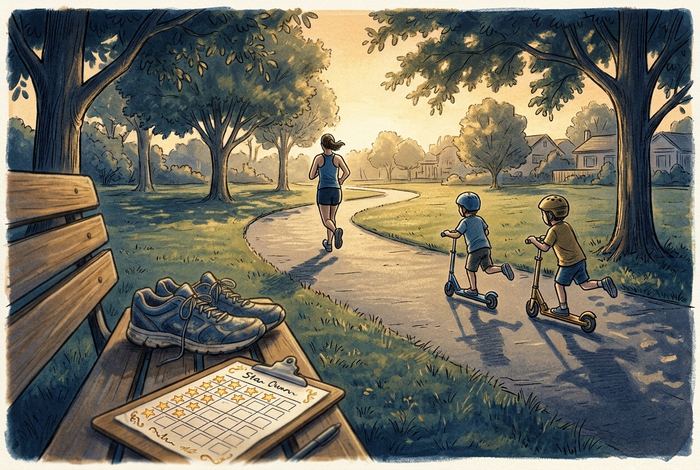
Starting again after a long hiatus is hard. Really hard. I followed a programme aptly named Couch to 5K. The first session was deceptively easy: five minutes of walking, 30 seconds of running, three minutes of walking, another 30 seconds of running, and so on for half an hour.
Anyone can run for 30 seconds, right? Until it’s the sixth time you’re running for 30 seconds, and you just don’t want to anymore.
Yes, yes, yada yada yada, health and longevity and all that. But for an ADHDer like me, long-term benefits don’t always deliver the immediate dopamine required to get through something unpleasant. I needed extrinsic motivation.
I needed a sticker.
If you’ve ever been in my classroom, you’ll know that I believe wholeheartedly in the power of a sticker. A reward. An irrefutable mark of success. A tiny, tangible declaration that a task has been completed and deserves a small token of joy.
So, like the parents of a toddler in the throes of toilet training, I made myself a star chart. Each completed run earned a sticker. Whenever I reached that inevitable point where the run became hard and I desperately wanted to stop, I reminded myself that I only got my sticker if I completed the entire session. So I kept going. I also, with absolutely no shame, proudly shared photographs of my growing sticker collection with friends.
Just like a freaking toddler.
But here’s what I’ve discovered.
Every run is its own kind of hard. And the only reason I can manage today’s hard run is because I did the hard run before it.
I no longer count the seconds. I count the kilometres.
We cannot control everything that is coming. But we can control how we meet it. Choosing to do the hard thing matters. Doing it when it sucks. Doing it when you’re tired. Doing it when the novelty has worn off and the finish line still feels impossibly far away.
Because every time you choose to keep going, you make the next hard thing a little more possible.
I started running because I was frightened of a future I couldn’t control. I kept running because I discovered something I could. Somewhere between the breathless 30-second intervals and the kilometres I can now manage, I learnt that doing hard things doesn’t necessarily make life less hard.
It makes us better equipped to face it.
So, is it really worth making the effort?
I believe it is.
Even if, sometimes, all it is for is a sticker.
Read more →
People of Action
Our Areas of Focus
Rotary channels its energy into seven
causes that build lasting change — in our community and around
the world. Every Wynberg project advances one of them.
Chartered in 1949, the Rotary Club of Wynberg brings together
20 dedicated professionals who give their time,
skills and energy to serve our community.
Meet our members →
We welcome professionals from all backgrounds who want to make a
difference in their community. Members meet weekly for fellowship
and hands-on service, joining a worldwide network of 1.4 million
Rotarians.
We run hands-on community projects across the Cape Peninsula
year-round, from feeding schemes to youth development.
Explore all our projects →